Articles features
Persecuted Muslim families get new homes in UP
Kandhla (Uttar Pradesh), Aug 15
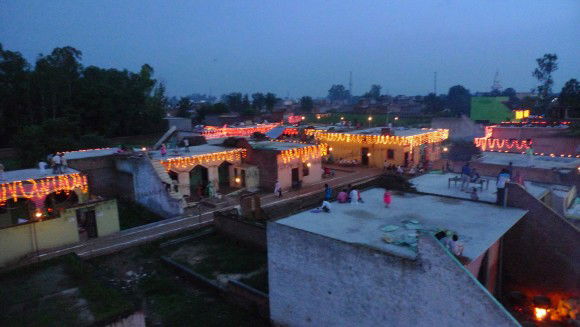
A hundred houses festooned with colourful bulbs lit up at once, shattering the darkness, literal and real.
Children broke into joyous rapture that is heard over the strident din of the generator used to power the bulbs. It was a spectacle the kids had not seen in three years, ever since a murderous mob drove them all out of their homes in a nearby village.
Subey Deen, 40, standing a few metres away from his new house, looked delighted. It was a far cry from that dark night of September 2013 when he and his family as well as hundreds of others were holed up in the house of a neighbour, an influential Jat, in Hasanpur village.
Outside, a frenzied crowd with firearms, blinded by communal passions and seething with rage, waited to wipe off the entire Muslim population of the village. Thanks to the army which intervened, all of them escaped.
Subey Deen shuddered over the past and quickly turned his gaze towards the lighted bulbs at his new home, one of the few which is bigger than others because he and his brothers pooled their resources.
"Sanstha ki madad ke bina ye ghar banana mushkil hota," (It would have been difficult to build this house without the NGOs' help)," Subey Deen told IANS.
He saw the house being built brick by brick with the help of some social activists and NGOs, primarily Sadbhavna Trust (Lucknow), Hunnarshala Foundation (Kutch) and Vanangana (Chitrakoot in UP).
Most affected families of Hasanpur, more than a hundred of them, decided to live at one place after the relief camp at Jaula village in Shamli was wound up. Of the 136 families, 121 got financial compensation from the Uttar Pradesh government.
Having spent a full year in the relief camp without work, and with a part of the compensation (Rs 5 lakh per family) gone into keeping themselves alive, the affected villagers had just enough to buy about 100 sq yards here at the rate of Rs 2,000-2,500 per sq yard.
With no cash in hand, and without any regular income, building a house was beyond their means.
The new colony, located on the outskirts of Kandhla town in Shamli district in western Uttar Pradesh, about 100 km from Delhi, is named Apna Ghar Colony. Some feel Hasan Basti would have been a more appropriate name as most of them have come from Hasanpur village, four kilometres away.
Earlier in the day, Praveen Davar, Member, National Commission for Minorities, along with former Planning Commission member Syeda Hameed and Noida District Magistrate N.P. Singh, who as the then chief of Shamli district, oversaw the rehabilitation of the riot hit families in 2014, unveiled a plaque to mark the new colony.
"I am extremely happy to see their life coming back on track. Once I saw tears in their eyes. I can still identify most of them by their names," Singh told IANS as the villagers crowded around and jostled to greet him.
"I took charge in February 2014. There were around 28,000 people in relief camps then. Within three months most were rehabilitated.
"Some were not genuine riot victims but made their way to the relief camps to get compensation. We identified them and sent them back," he said.
It was thanks to Singh and another senior official, Tanveer Zafar, that many displaced families secured compensation. They were earlier denied any help on the grounds that no violence occurred in their villages.
Subey Deen has resumed the 'pheri' (door to door marketing) he used to do in cities like Delhi, Pune, Kolhapur and Nagpur. Most men in the colony do the same, selling bedsheets and clothes of all varieties.
A few work in a nearby brick kiln.
Social activist Farah Naqvi, who has worked for the rehabilitation of the victims from Hasanpur village from day one, was all smiles at the fruition of their efforts.
"Rehabilitation is not just about building a few 10x10 structures and donating them to the victims. Comprehensive rehabilitation is about helping the survivors create an integrated community. And that is what we want to demonstrate through this rehabilitation process," Naqvi told IANS.
Sandeep Virmani, an architect and Vice Chairman of Hunnarshala Foundation, added: "We did not build their houses. We helped them design their own houses according to their needs and comfort. In fact, we also learnt local techniques like 'daat ki chhat' (shallow masonry dome roof) from them."
Naqvi recalled how it required a lot of effort to send the affected children back to school.
"On the one hand we had to persuade the parents to send their kids to school. They were apprehensive to part with their children even for a few hours after what they had gone through.
"On the other hand, we had to beg the school authorities to admit the children. All the kids are now older for their classes and they regret the loss of two years," Naqvi said.
"Ab toh sab theek hai (Things are all right now)," said Subey Deen, whose extended family includes his elderly parents.
As Madhavi Kuckreja of Sadbhavna Trust said: "This is not charity. We did this to show how to reconstruct the web of life that is torn during communal riots. It is not only about brick and mortar homes."
(Mohd Asim Khan can be contacted on mohd.a@ians.in)

Children broke into joyous rapture that is heard over the strident din of the generator used to power the bulbs. It was a spectacle the kids had not seen in three years, ever since a murderous mob drove them all out of their homes in a nearby village.
Subey Deen, 40, standing a few metres away from his new house, looked delighted. It was a far cry from that dark night of September 2013 when he and his family as well as hundreds of others were holed up in the house of a neighbour, an influential Jat, in Hasanpur village.
Outside, a frenzied crowd with firearms, blinded by communal passions and seething with rage, waited to wipe off the entire Muslim population of the village. Thanks to the army which intervened, all of them escaped.
Subey Deen shuddered over the past and quickly turned his gaze towards the lighted bulbs at his new home, one of the few which is bigger than others because he and his brothers pooled their resources.
"Sanstha ki madad ke bina ye ghar banana mushkil hota," (It would have been difficult to build this house without the NGOs' help)," Subey Deen told IANS.
He saw the house being built brick by brick with the help of some social activists and NGOs, primarily Sadbhavna Trust (Lucknow), Hunnarshala Foundation (Kutch) and Vanangana (Chitrakoot in UP).
Most affected families of Hasanpur, more than a hundred of them, decided to live at one place after the relief camp at Jaula village in Shamli was wound up. Of the 136 families, 121 got financial compensation from the Uttar Pradesh government.
Having spent a full year in the relief camp without work, and with a part of the compensation (Rs 5 lakh per family) gone into keeping themselves alive, the affected villagers had just enough to buy about 100 sq yards here at the rate of Rs 2,000-2,500 per sq yard.
With no cash in hand, and without any regular income, building a house was beyond their means.
The new colony, located on the outskirts of Kandhla town in Shamli district in western Uttar Pradesh, about 100 km from Delhi, is named Apna Ghar Colony. Some feel Hasan Basti would have been a more appropriate name as most of them have come from Hasanpur village, four kilometres away.
Earlier in the day, Praveen Davar, Member, National Commission for Minorities, along with former Planning Commission member Syeda Hameed and Noida District Magistrate N.P. Singh, who as the then chief of Shamli district, oversaw the rehabilitation of the riot hit families in 2014, unveiled a plaque to mark the new colony.
"I am extremely happy to see their life coming back on track. Once I saw tears in their eyes. I can still identify most of them by their names," Singh told IANS as the villagers crowded around and jostled to greet him.
"I took charge in February 2014. There were around 28,000 people in relief camps then. Within three months most were rehabilitated.
"Some were not genuine riot victims but made their way to the relief camps to get compensation. We identified them and sent them back," he said.
It was thanks to Singh and another senior official, Tanveer Zafar, that many displaced families secured compensation. They were earlier denied any help on the grounds that no violence occurred in their villages.
Subey Deen has resumed the 'pheri' (door to door marketing) he used to do in cities like Delhi, Pune, Kolhapur and Nagpur. Most men in the colony do the same, selling bedsheets and clothes of all varieties.
A few work in a nearby brick kiln.
Social activist Farah Naqvi, who has worked for the rehabilitation of the victims from Hasanpur village from day one, was all smiles at the fruition of their efforts.
"Rehabilitation is not just about building a few 10x10 structures and donating them to the victims. Comprehensive rehabilitation is about helping the survivors create an integrated community. And that is what we want to demonstrate through this rehabilitation process," Naqvi told IANS.
Sandeep Virmani, an architect and Vice Chairman of Hunnarshala Foundation, added: "We did not build their houses. We helped them design their own houses according to their needs and comfort. In fact, we also learnt local techniques like 'daat ki chhat' (shallow masonry dome roof) from them."
Naqvi recalled how it required a lot of effort to send the affected children back to school.
"On the one hand we had to persuade the parents to send their kids to school. They were apprehensive to part with their children even for a few hours after what they had gone through.
"On the other hand, we had to beg the school authorities to admit the children. All the kids are now older for their classes and they regret the loss of two years," Naqvi said.
"Ab toh sab theek hai (Things are all right now)," said Subey Deen, whose extended family includes his elderly parents.
As Madhavi Kuckreja of Sadbhavna Trust said: "This is not charity. We did this to show how to reconstruct the web of life that is torn during communal riots. It is not only about brick and mortar homes."
(Mohd Asim Khan can be contacted on mohd.a@ians.in)
16 hours ago
Pakistan opposes Hamas disarmament clause, sets conditions to join US-backed Gaza peace force
22 hours ago
Indian startup, KPro.ai, to deploy performance analytics at Kyrgios-Sabalenka 'Battle of Sexes' match in Dubai
22 hours ago
Japan's record defence budget plan sparks public concern
22 hours ago
Kathmandu Mayor Balen Shah named RSP's Nepalese PM candidate
22 hours ago
Rise and fall of former ISI chief encapsulate structural tensions at heart of Pakistan’s civil–military order: Report
22 hours ago
Canadian PM announces new support for Ukraine in meeting with Zelensky
22 hours ago
Winter storm hits US, snarls thousands of flights
22 hours ago
Indian American-led county in Pennsylvania passes rare bipartisan budget
22 hours ago
US condemns killing of Hindu worker, urges Bangladesh to protect minorities
22 hours ago
Why Europe should be worried about Pakistan's terror ecosystem
22 hours ago
From Op Sindoor to Ram Temple flag hoisting: PM Modi says 2025 gave India 'greater self-confidence'
22 hours ago
'Digvijaya Singh realising BJP’s organisational strength after long time': Ravi Shankar Prasad
22 hours ago
Telangana suicide case: Woman's family stages protest with her body in front of lover's house