














Articles features
Five degree mercury rise in Hindu Kush by 2050, warn experts
New Delhi, Dec 11
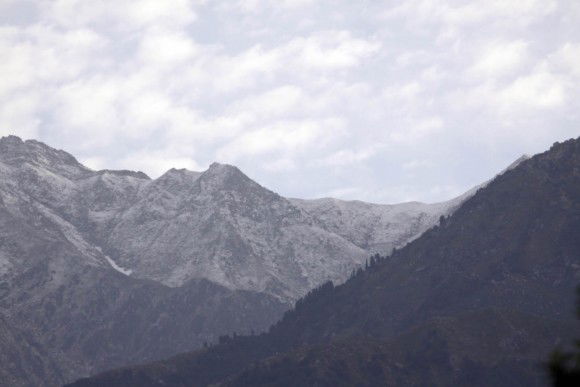
Temperatures across the Hindu Kush, a mountain range extending west of the Himalayas, will increase by about one to two degrees Celsius, in some places by four to five degrees, in the next 35 years, international researchers said on Friday.
They warned that extreme rainfall events are becoming less frequent but more violent and are likely to increase in intensity.
These startling facts came to light in a climate and water atlas, "Mapping an uncertain future: Atlas of climate change and water in five crucial water basins in the Hindu Kush Himalayas", published by three international institutes.
They are the International Centre for Integrated Mountain Development (ICIMOD), GRID-Arendal, a Norwegian Foundation, and the Centre for International Climate and Environmental Research-Oslo (CICERO).
The first-of-its-kind atlas offers a comprehensive, regional understanding of the changing climate and its impact on water resources in five of the major river basins - the Indus, the Brahmaputra, the Ganges, the Salween and the Mekong.
The atlas was released jointly by the research institutes on the sidelines of the Paris COP-21 to mark International Mountain Day on Friday.
"This atlas sheds light on the state and fate of the water resources of the Hindu Kush Himalayas, a region that is highly vulnerable to climate change and one of the poorest regions in the world," Kathmandu-based ICIMOD director general David Molden told IANS in an email.
The information in the atlas presents science-based information that will help develop solutions and take the necessary action to deal with changes in the region, he added.
It uses maps and info graphics to show how the region's climate is changing now and into the future, with severe consequences for populations - both local and downstream.
Increased temperatures by 2050 will not only increase the rates of snow and ice melt but can also result in a change of precipitation, with the main loss in the Indus basin. Communities living immediately downstream from the glaciers are the most vulnerable to glacial changes.
The Hindu Kush Himalayan region is home to 210 million people and providing water to over 1.3 billion people - more than the entire continent of Europe.
Precipitation will change with the monsoon expected to become longer and more erratic, said the researchers.
Despite the overall greater river flow projected, higher variability in river flows and more water in pre-monsoon months are expected, which will lead to a higher incidence of unexpected floods and droughts, greatly impacting on the livelihood security and agriculture of river-dependent people, they said.
Changes in temperature and precipitation will have serious and far-reaching consequences for climate-dependent sectors, such as agriculture, water resources and health.
The atlas stresses on development of flexible and cooperative strategies among countries to meet the challenges posed by either too much or too little water.
(Vishal Gulati can be contacted at vishal.g@ians.in)
They warned that extreme rainfall events are becoming less frequent but more violent and are likely to increase in intensity.
These startling facts came to light in a climate and water atlas, "Mapping an uncertain future: Atlas of climate change and water in five crucial water basins in the Hindu Kush Himalayas", published by three international institutes.
They are the International Centre for Integrated Mountain Development (ICIMOD), GRID-Arendal, a Norwegian Foundation, and the Centre for International Climate and Environmental Research-Oslo (CICERO).
The first-of-its-kind atlas offers a comprehensive, regional understanding of the changing climate and its impact on water resources in five of the major river basins - the Indus, the Brahmaputra, the Ganges, the Salween and the Mekong.
The atlas was released jointly by the research institutes on the sidelines of the Paris COP-21 to mark International Mountain Day on Friday.
"This atlas sheds light on the state and fate of the water resources of the Hindu Kush Himalayas, a region that is highly vulnerable to climate change and one of the poorest regions in the world," Kathmandu-based ICIMOD director general David Molden told IANS in an email.
The information in the atlas presents science-based information that will help develop solutions and take the necessary action to deal with changes in the region, he added.
It uses maps and info graphics to show how the region's climate is changing now and into the future, with severe consequences for populations - both local and downstream.
Increased temperatures by 2050 will not only increase the rates of snow and ice melt but can also result in a change of precipitation, with the main loss in the Indus basin. Communities living immediately downstream from the glaciers are the most vulnerable to glacial changes.
The Hindu Kush Himalayan region is home to 210 million people and providing water to over 1.3 billion people - more than the entire continent of Europe.
Precipitation will change with the monsoon expected to become longer and more erratic, said the researchers.
Despite the overall greater river flow projected, higher variability in river flows and more water in pre-monsoon months are expected, which will lead to a higher incidence of unexpected floods and droughts, greatly impacting on the livelihood security and agriculture of river-dependent people, they said.
Changes in temperature and precipitation will have serious and far-reaching consequences for climate-dependent sectors, such as agriculture, water resources and health.
The atlas stresses on development of flexible and cooperative strategies among countries to meet the challenges posed by either too much or too little water.
(Vishal Gulati can be contacted at vishal.g@ians.in)

3 hours ago
Ready for another year of even stronger ties with India: US Embassy

9 hours ago
Mere reference to caste status insufficient to attract SC/ST Act: Allahabad HC

9 hours ago
Sabarimala gold theft case: Bid to sabotage SIT probe, says Cong; seeks HC intervention

11 hours ago
At Sivagiri, K'taka CM says religion without ethics becomes tool of domination

11 hours ago
Rohit Roy shares heartwarming story of stranger’s kindness after his car stranded on road

11 hours ago
Kalki Koechlin on how her character’s fictional nature in 'Bhay' allowed emotional access

11 hours ago
Riddhi Kumar plays Anitha in Prabhas-starrer 'The Raja Saab'

11 hours ago
Genelia Deshmukh wraps up 2025 by cherishing precious moments that matter the most

11 hours ago
Imran Khan bids adieu to 2025 by recalling his film on India’s Mangalyaan mission

11 hours ago
Kavita Kaushik reflects on missing the version of herself she was when her father was around

11 hours ago
Soha Ali Khan advocates for forest protection after spending 3 days in the wild with her family

11 hours ago
Bus row intensifies between Kerala Minister and Thiruvananthapuram Mayor

11 hours ago
SIT to take statement from UDF convener Adoor Prakash in Sabarimala gold theft case