Washington, Dec 20,
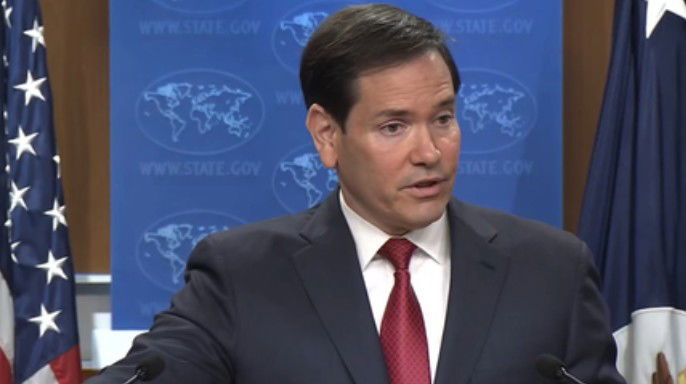
The press conference did not begin the way Washington press conferences usually do. Instead of calling on the familiar front row, Secretary of State Marco Rubio leaned back slightly, scanned the room, and announced a reversal of ritual. "I'm going to start from the back row forward," he said. Then he did exactly that.
Over the next two-plus hours, Rubio worked his way methodically toward the podium, giving every raised hand a chance, pausing for follow-ups, and circling back when he sensed someone had been skipped. "I'll be here pretty long, so don't get desperate, don't get wild," he told reporters early on -- a promise he largely kept.
It was a small procedural choice, but it set the tone for what followed: an unhurried, expansive year-ender conversation less about sound bites than about sorting through a crowded global agenda and acknowledging the limits of American power.
From the outset, Rubio framed the moment as one of reassessment rather than assertion. "At the core of foreign policy needs to be the national interest of the United States," he said, returning repeatedly to the idea that foreign policy is, above all, an exercise in prioritisation.
"Resources have limited time, and it has to be able to dedicate those resources and time through a process of prioritisation," Rubio said, adding that the world for which US foreign policy institutions were originally designed "no longer existed".
That recalibration, he argued, does not mean disengagement. "That doesn't mean we don't care about what happens in the world," he said. But caring, in Rubio's telling, has to be matched with discipline -- and with clarity about what US power can realistically achieve.
As the questions moved region by region, another departure from Washington norms became clear. Rubio shifted easily between English and Spanish, taking nearly a quarter of the questions in Spanish and answering them first in that language before restating them in English for the room.
"I can do English. I'll answer Spanish if you ask Spanish, and then I'll answer it in English," he said early on.
The effect was more than linguistic. Questions on Venezuela, Colombia, narcotics trafficking, and hemispheric security flowed naturally in Spanish, and Rubio treated them not as peripheral concerns but as central elements of US foreign policy.
The Western Hemisphere, often crowded out by crises elsewhere, featured prominently -- and forcefully.
"There's one place that doesn't cooperate, and it's the illegitimate regime in Venezuela," Rubio said, accusing Caracas of openly working with "terrorists and criminal elements" and cooperating with drug trafficking organisations.
Elsewhere in the region, he struck a different note. "So the good news is we have a lot of countries in the region that openly cooperate and work with us," Rubio said, singling out Mexico, where he said cooperation with the US is "the highest it's ever been in their history."
If Latin America reflected sharper contrasts, the Middle East revealed cautious sequencing. In Gaza, Rubio acknowledged that the war is not over, but insisted its character has changed. "There is now a ceasefire," he said, adding that "there's more work to remain."
The path forward, he suggested, begins not with troops but with governance. "The next step here is announcing the Board of Peace, announcing the Palestinian technocratic group that will help provide daily governance," Rubio said.
Only after that, he said, can questions of stabilisation forces be resolved. Pakistan emerged in that context as a potential contributor. "We're very grateful to Pakistan for their offer to be a part of it or at least their offer to consider being a part of it," Rubio said, while stressing that countries want clarity on "what the mandate is" and "what the funding mechanism looks like."
In Ukraine, the tone shifted from cautious optimism to blunt realism. "We don't see surrender anytime in the near future by either side," Rubio said, framing negotiation as a necessity rather than a preference.
"There's only one nation on earth… that can actually talk to both sides," he said. "And that's the United States." But he was equally clear about limits. "This is not about imposing a deal on anybody," Rubio said. "The decision will be up to Ukraine and up to Russia."
Across the Indo-Pacific, Rubio rejected the idea of clean binaries. "Look, there will be tensions, there's no doubt about it," he said of China, calling it "a rich and powerful country and a factor in geopolitics."
"We have to have relations with them. We have to deal with them," Rubio said, even as he reaffirmed alliances with Japan and partnerships across the Indo-Pacific, including India.
The task, he suggested, was not to eliminate tension but to manage it -- to "balance these two things."
Sudan, by contrast, was described in moral terms stripped of diplomatic varnish. "What's happening there is horrifying," Rubio said, lamenting broken commitments and external interference. The priority, he said, is singular. "Our number one priority… 99 per cent of our focus is this humanitarian truce."
Even in Lebanon and Israel, Rubio resisted predictions. "No one is in favour of a Hezbollah that can once again threaten Israel's security," he said, stressing that lasting stability depends on "a strong Lebanese government that can actually control the country."
By the time Rubio reached the front row -- more than two hours after he began -- the press conference felt less like a performance than a working session. The back-to-front format, the bilingual exchanges, and the absence of clock-watching reinforced a message he returned to again and again: diplomacy is slow, imperfect, and constrained by realities that slogans cannot erase.
"Foreign aid is not charity," Rubio said at one point. "It's an act of the US taxpayer."
Power, in Rubio's telling, is finite. Peace is conditional. And foreign policy, stripped of rhetoric, is the hard work of choosing where to act, where to press, and where to accept limits.
In a world crowded with overlapping wars and competing urgencies, Rubio's long year-ender offered not a grand doctrine, but a method -- one rooted in national interest, shaped by constraint, and carried out, question by question, from the back of the room forward.